


For years, if you wanted a 6K display, you had one real option: Apple's Pro Display XDR at $4,999.
That's a lot of money for a monitor, even if it's excellent. But this year, manufacturers finally figured out that there's a market for high-resolution displays that don't require taking out a second mortgage.
Dell, Acer, Samsung, and LG have all announced 6K monitors coming in 2026, and although the price range is a bit all over the place, there are still options coming in below $1,500 ($1,499 for Acer's ProDesigner PE320QX), which is honestly something I didn’t expect to see this soon.
So if you’ve been stuck deciding between 4K (which can feel cramped at 32 inches) and jumping all the way to something ultra-premium, 2026 might finally give you a middle ground.
I've spent weeks researching everything there is to know about the 6K monitors coming out this year, and I'm going to walk you through what's available, what's worth buying, and what you should skip.
Let’s get to it!
Why 6K Matters (and When It Doesn't)
Let's start with the obvious question: Do you actually need 6K resolution?
For most people, the answer is no. A good 4K monitor (like the Dell UltraSharp U2720Q or LG 27GP950-B) at 27 or 32 inches delivers plenty of screen real estate and sharp text for productivity work. If you're gaming, 4K is already pushing most GPUs hard. Going to 6K means you need even more graphics horsepower for diminishing returns.
But there are use cases where 6K makes sense. For example, if you're a photographer editing high-resolution images, a video editor working with 4K or 8K footage, or a designer who needs to see fine details, 6K delivers real benefits. It gives you a more usable workspace and the ability to see your content at near-native resolution without constantly zooming in and out.
Dell UltraSharp 52 Thunderbolt Hub Monitor: The Productivity Beast
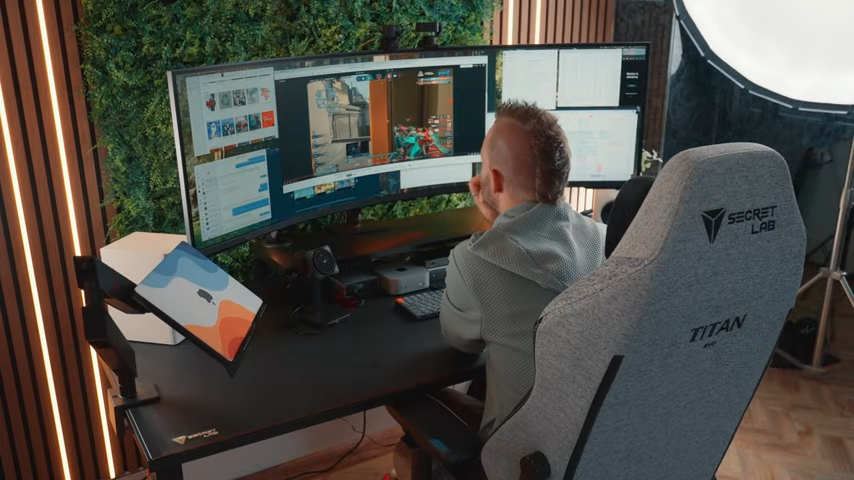
I bought the Dell UltraSharp 52 Thunderbolt Hub Monitor, and it's been sitting on my desk for weeks. It's the world's first 52-inch 6K display, and it's designed for people who want everything connected through one massive screen.
What makes this monitor special is the connectivity. You get a Thunderbolt 4 hub with 140W power delivery, 2.5 gig Ethernet, four USB-A 3.2 Gen 2 ports, two USB-C downstream ports with 27W power delivery each, two HDMI 2.1 ports, and two DisplayPort 1.4 ports. There's also a pop-down tray for additional USB connections.
The KVM functionality supports up to four sources. I have my MacBook Air and gaming PC connected, and I can switch between them without unplugging anything. My audio interface, webcam, and keyboard dongles stay connected to the monitor.
The picture quality is excellent for productivity. The IPS Black panel delivers accurate colors with less blooming than mini LED displays. Text looks crisp at my normal sitting distance of about 2 feet, and Mac scaling works perfectly.
All in all, this is the most complete productivity monitor I’ve used in years. But it comes with a higher price tag of $2,899.99 with the stand (or $2,799 without).
Acer ProDesigner PE320QX: 6K on a Budget
Acer's ProDesigner PE320QX is the most affordable 6K monitor announced for 2026, and it's aimed squarely at creative professionals who want high pixel density without spending $5,000.
At 31.5 inches with 6016×3384 resolution, you get about 220 pixels per inch. That's about the same pixel density as Apple's Pro Display XDR, but at less than a third of the price. The IPS-LCD panel includes USB4 connectivity, 100W power delivery, dual 5-watt speakers, a proximity sensor that dims the display when you step away, and VESA DisplayHDR 600 certification.
The price is $1,499, and it's shipping in Q2 2026. That makes it the most accessible entry point for 6K displays.
Here's the catch. We don't know much about the panel quality yet. Acer hasn't released detailed specs on color accuracy, contrast ratio, or brightness uniformity. The 100W power delivery is lower than Dell's 140W, which might not be enough for some laptops under heavy load. And the dual 5-watt speakers are going to be mediocre at best.
But for photographers, video editors, and designers who want maximum pixel density for detail work, this is worth considering. Just wait for reviews before buying. We need to see how the panel performs in the real world first.
Samsung Odyssey 3D: 6K Glasses-Free 3D Gaming
Samsung's Odyssey 3D (model G90XH) is the world's first 6K display with glasses-free 3D technology, and it's one of the most interesting monitors announced at CES 2026.
It's a 32-inch IPS panel with 6144×3456 resolution, 165Hz refresh rate (330Hz in Dual Mode at 3K), and 1ms GtG response time. The glasses-free 3D works through real-time eye tracking. The monitor adjusts depth and perspective based on where you're sitting, creating a layered sense of dimension without needing a headset or glasses.
Samsung partnered with game studios to optimize 3D effects for specific titles. For example, The First Berserker: Khazan, Lies of P: Overture, and Stellar Blade will all support enhanced 3D visuals.
My only concern is that Samsung's first Odyssey 3D monitor (27-inch 4K model from 2025) was impressive tech, but it was hard to recommend due to limited game support and high price. This 32-inch 6K model will likely cost over $2,000, and we still don't know how many games will support the 3D features.
If you're curious about glasses-free 3D and have money to spend on experimental tech, this could be interesting. For everyone else, wait and see how the game support develops.
Pricing and availability are TBA, but expect it to launch sometime in 2026.
Samsung Odyssey G8: 6K for Gamers
Samsung's Odyssey G8 lineup includes a 32-inch 6K model (G80HS) that's positioned as the industry's first 6K gaming monitor.
The specs are similar to the Odyssey 3D but without the 3D features. You get a 32-inch IPS panel with 6144×3456 resolution, 165Hz refresh rate (330Hz in Dual Mode at 3K), HDMI 2.1, DisplayPort 2.1, AMD FreeSync Premium Pro, and NVIDIA G-Sync Compatible support.
This is a more straightforward option if you want 6K resolution for gaming and productivity, without paying for 3D technology you might not use. But we don't have pricing or availability yet, and I'm skeptical about the value proposition.
The problem, though, is that most games don't support 6K resolution natively, and so you'll be dropping to 4K or lower for most titles. And even with a high-end GPU, driving 6K at high frame rates is challenging. The 165Hz refresh rate is fine for single-player games, but competitive gamers will want 240Hz or higher.
If you mainly game and occasionally do creative work, you're better off with a 4K OLED at 240Hz or a high-refresh 1440p display. The 6K resolution doesn't add enough value for gaming to justify what will likely be a premium price.
If you’re intrigued by this option, my advice would be to wait for pricing and reviews before getting serious about buying.
LG UltraFine 32U990A-S: Thunderbolt 5 Integration
LG's 32-inch UltraFine monitor (model 32U990A-S) is a 6K Nano IPS Black display with Thunderbolt 5 connectivity, and it's aimed at Mac users and creative professionals who want a single-cable solution.
The resolution is 6016×3384, giving you 224 pixels per inch on a 32-inch panel. The Nano IPS Black technology delivers high contrast and ultra-clear visuals. Thunderbolt 5 provides ultra-fast data transfer, power delivery, and display connectivity through one cable.
LG hasn't announced pricing or availability yet, but expect it to be positioned as a premium option. Previous LG UltraFine displays have been priced competitively against Apple's offerings, so this could come in around $2,000 to $2,500.
The Thunderbolt 5 integration is the main selling point. If you're running a Mac and want to connect everything through one cable with maximum bandwidth, this makes sense. For everyone else, Thunderbolt 4 is probably sufficient.
The Best 6K Monitors 2026 Ranked
Based on what's announced and available, here's my ranking of the best 6K monitors 2026 has to offer.
- Best Overall: Dell UltraSharp 52 Thunderbolt Hub Monitor ($2,899.99, available now). The connectivity, screen real estate, and productivity features make this the best all-around option if you have the budget and desk space.
- Best Value: Acer ProDesigner PE320QX ($1,499, expected in Q2 2026). At less than a third the price of Apple's Pro Display XDR, this is the most accessible 6K option for creative professionals. Wait for reviews to confirm panel quality.
- Best for Mac Users: LG UltraFine 32U990A-S (price TBA, availability TBA). Thunderbolt 5 integration and Nano IPS Black technology make this the natural choice for Mac-centric workflows. Wait for official pricing.
- Most Interesting Tech: Samsung Odyssey 3D (price TBA, availability TBA). Glasses-free 3D at 6K resolution is impressive, but limited game support and unknown pricing make this a wait-and-see option.
Skip: Samsung Odyssey G8 6K gaming monitors. Most games don't support 6K natively, and you're better off with a 4K OLED or high-refresh 1440p display for gaming.
Final Thoughts: Is 6K Finally Worth It?
For the first time ever, 6K isn’t a one-monitor conversation. You don’t have to default to Apple, you don’t have to spend $5,000, and you don’t have to pretend 4K is “good enough” if you genuinely need more space or pixel density.
However: 6K is still niche, and the pricing reflects that.
So if you’re gaming first and working second, you’ll get more value from a high-refresh 4K OLED or a fast 1440p display. And if you’re casually browsing, emailing, and watching YouTube, 4K still remains the sweet spot.
6K starts to make sense when your work benefits from precision and space. For example, if you work with:
- High-resolution photography
- 4K/8K video editing
- UI/UX design
- Large spreadsheets
- Coding across multiple windows
If your current 4K monitor feels cramped and you’ve been waiting for prices to normalize, this might finally be your year to upgrade. My only advice is to just make sure you’re upgrading for the right reasons (not just because the number is bigger).
