


Apple has brought Touch ID back to a flagship iPhone. I didn't have that particularly high on my list of things I expected to happen in 2026, but here we are.
The new iPhone Duo uses Touch ID integrated into its side button, allowing you to unlock the phone and authenticate purchases with your fingerprint whether the device is open or closed. Does iPhone Duo have Face ID? Not according to Apple's specifications.
That's a pretty big change if you're coming from another modern iPhone. Apple introduced Face ID with the iPhone X back in 2017, and it has been the standard biometric authentication system on the company's premium phones ever since. Even as Touch ID continued to appear on other Apple products, flagship iPhones moved firmly towards facial recognition.
Then Apple made an iPhone that folds in half and apparently decided it was time to dust off the fingerprints again.
The obvious question with iPhone Duo Touch ID is why.
Apple hasn't given a detailed public explanation for omitting Face ID from the iPhone Duo, so there are limits to what we can state as fact. What we do know is how the Duo is constructed, where its cameras and sensors are located, and how Apple has designed Touch ID to work across both folded and unfolded use.
That gives us a lot to talk about without pretending we were sitting in Apple's engineering meetings.
The fast version
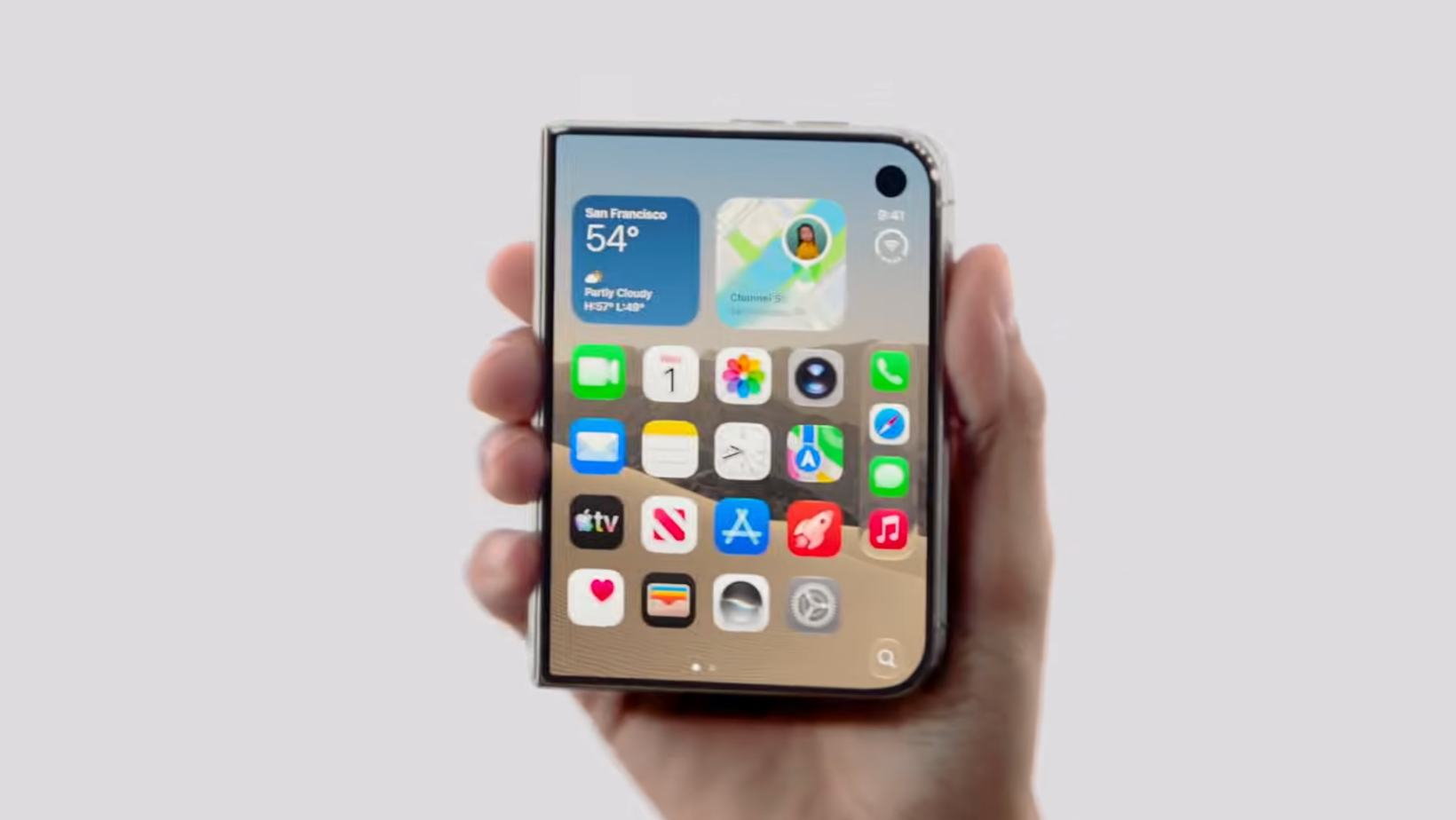
- The iPhone Duo does not use Face ID. Apple has instead integrated Touch ID into the side button.
- Touch ID works whether the Duo is open or closed, which gives Apple one authentication method that remains accessible across both physical configurations.
- You can also unlock the iPhone Duo with an Apple Watch, just as Apple supports watch-assisted unlocking elsewhere in its ecosystem.
- Apple hasn't officially explained why Face ID was omitted. The Duo's unusually thin folding design and multiple displays provide some obvious engineering context, but anything beyond Apple's confirmed specifications should be treated as interpretation rather than fact.
Does the iPhone Duo have Face ID?
No. Apple does not list Face ID as an authentication feature on the iPhone Duo. Instead, the phone uses a Touch ID fingerprint sensor integrated into the side button.
Apple's pitch is that you get the same reliable authentication no matter which state the phone is in. You can use it to unlock the Duo, authenticate Apple Pay transactions, and handle the other security checks you would normally expect from biometric authentication on an iPhone.
The Home button stays retired
This isn't the old Home button coming back. Apple hasn't suddenly carved a circle into the bottom of its new $1,999 foldable.
The implementation is much closer to the Touch ID system we've seen on certain iPads, where the fingerprint sensor is incorporated into a physical button around the edge of the device.
For a foldable, that location makes a lot of sense.
How does Touch ID work on the iPhone Duo?
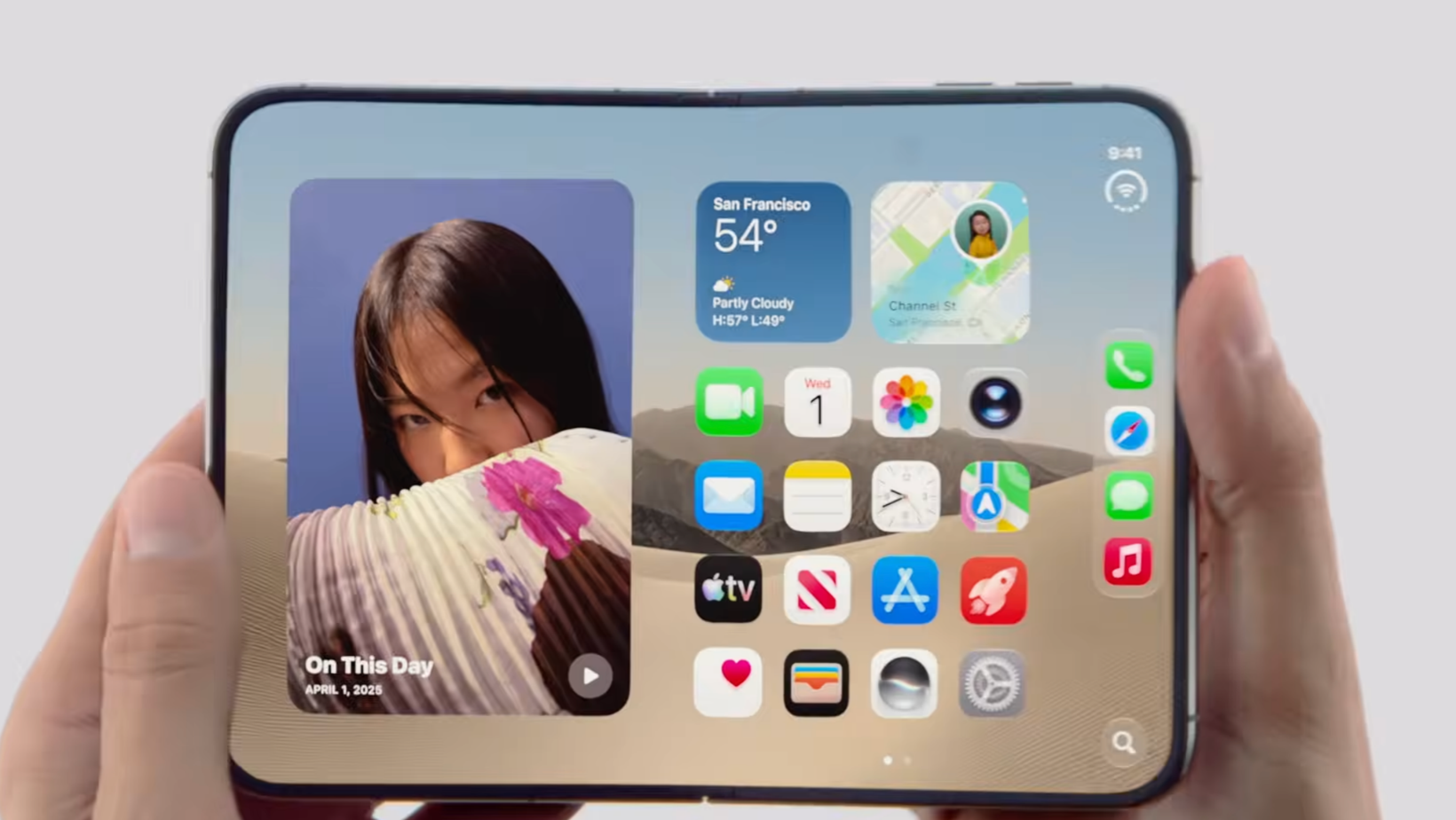
iPhone Duo Touch ID lives inside the side button. That means the same sensor remains available when you're using the 5.4-inch outer display with the Duo closed and when you've opened the phone to use its 7.6-inch inner display.
You touch the side button with your registered finger; the phone verifies the fingerprint and authentication takes place without requiring a dedicated sensor on either display.
Open or closed, always in reach
The placement is particularly interesting because a foldable phone has to work in several physical configurations.
You may be holding it closed like a conventional phone, holding it open with two hands, or placing it partly folded on a desk. Building biometric authentication into the frame means Apple doesn't need you to interact with one specific display to identify yourself.
Apple's specific claim is that Touch ID works just as easily no matter how the Duo is positioned.
That's probably the most important thing to understand about the decision from a usability perspective.
Whatever engineering discussions happened behind the scenes, Apple has ended up with one biometric system that's accessible in both of the Duo's main configurations.
So where did Face ID go?
This is where we need to distinguish between what Apple has confirmed and what we can reasonably infer from the hardware.
Apple has not published an official explanation saying why Face ID was left out of the iPhone Duo.
So if you see somebody confidently declaring that Apple removed it for one specific reason, they're filling in a gap Apple itself hasn't filled.
What we can say is that the Duo presents Apple with a very different hardware problem from a conventional iPhone.
Face ID needs a lot of hardware
Face ID isn't just one camera pointed at your face. Apple's TrueDepth system packs in a bunch of components to map and verify you securely, and a normal iPhone only has to squeeze all that around one screen.
A normal iPhone only needs to accommodate that system around one primary display.
The Duo has two displays, including an extremely thin folding inner section. Opened, the device measures only 5.2mm thick, and Apple has already had to rethink how it incorporates the inner FaceTime camera to avoid interrupting the large display.
That makes space inside the phone particularly valuable.
Reading between the lines
It's therefore reasonable to look at the Duo's physical design as relevant context for Apple's authentication choice. It would not, however, be accurate to say Apple has confirmed that thinness, hinge packaging, or component space is the reason Face ID isn't present.
For now, the official answer is simply that Apple designed the Duo around side-button Touch ID instead.
The vanishing camera clue
One detail I find particularly interesting is what Apple has done with the inner FaceTime camera.
Rather than placing it inside a Dynamic Island, Apple has positioned the camera beneath the 7.6-inch inner display so that it stays hidden when it isn't being used.
That's clearly part of Apple's attempt to make the unfolded screen feel like one large, uninterrupted canvas.
It also shows how different the priorities are on the Duo.
Apple hid the inner camera for a reason
Apple has spent years turning the Dynamic Island into both a design feature and a functional part of iOS on conventional iPhones. On the Duo's main screen, it has gone in the opposite direction and tried to make the camera disappear.
Adding the full set of hardware required for Face ID would create another design and packaging challenge around that display.
Again, Apple hasn't said that's why Face ID was omitted, so I wouldn't present it as the definitive explanation. But when you look at a phone that's 5.2mm thick when open and deliberately hides its inner camera beneath the display, you can at least understand why authentication might need a different approach.
Why not put Face ID on the outside?
This was my next thought. The Duo has a 5.4-inch outer display that works much more like the screen on a conventional iPhone. It even has a Dynamic Island.
So why not put Face ID there? The problem is that you'd then have a biometric system associated primarily with one side of a phone designed to be used in several different ways.
One-sided security has a catch
Imagine you're working with the Duo fully open and need to authenticate something. Depending on the implementation, you could potentially need to reposition the device so that the outer Face ID system could see you.
That's hardly the smooth, futuristic foldable experience Apple is selling.
Touch ID in the side button avoids that issue because the sensor remains physically accessible in both states.
It isn't necessarily as futuristic as facial recognition, but foldable phones are a good reminder that sometimes the less exciting technology fits the form factor better.
Touch ID feels right at home on a foldable
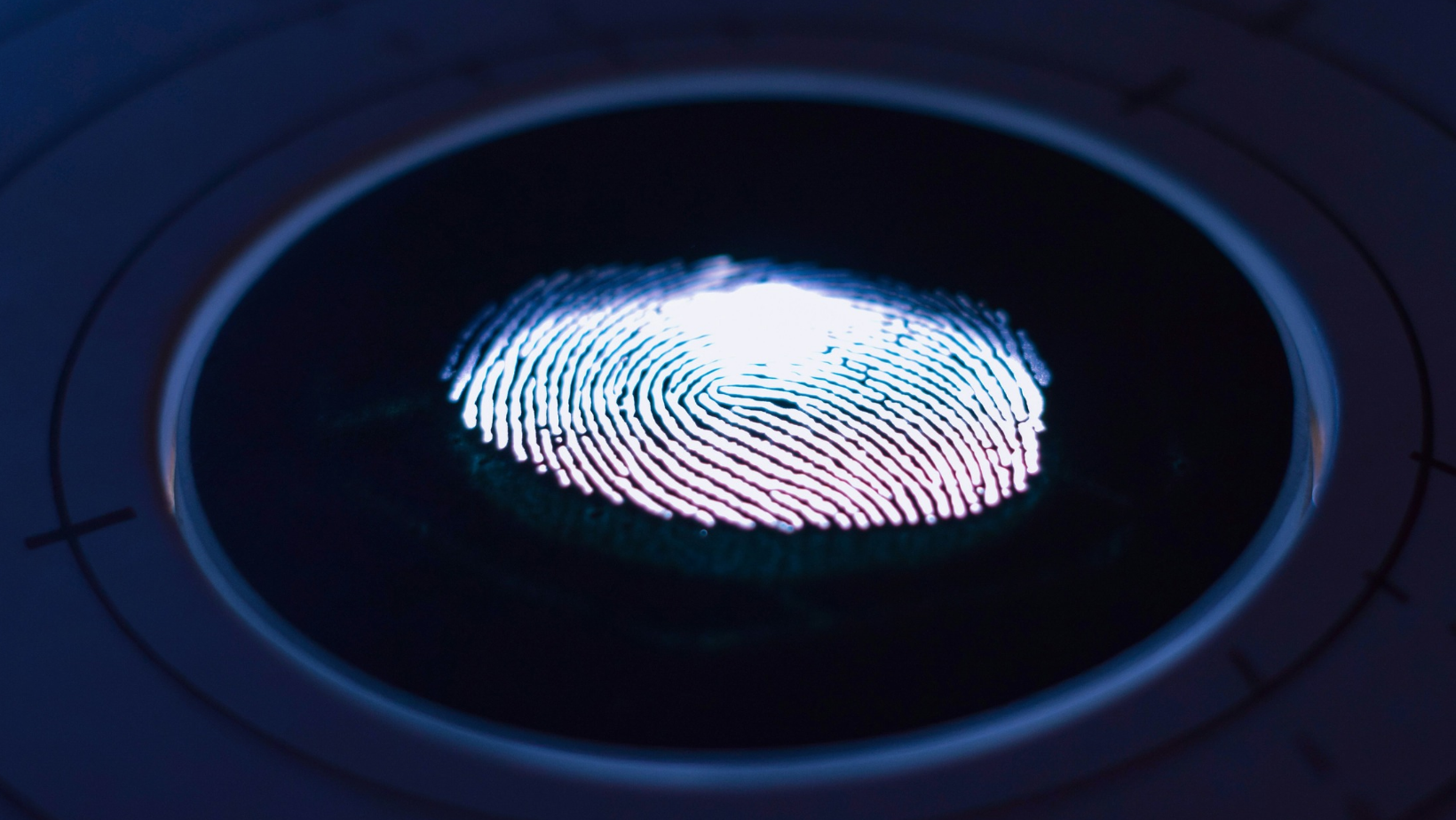
I've become so used to Face ID that going back to fingerprint authentication initially sounds like a downgrade.
In some situations, though, I can see Touch ID working particularly well on the Duo. The most obvious is when the phone is sitting on a desk.
The Duo can be partly folded and used hands-free, which is useful for video calls, watching content, and some of Apple's new StandBy features. If the device is positioned at an awkward angle, facial recognition may not always be the authentication method you'd naturally want to use.
Your finger does the work
The iPhone Duo fingerprint sensor doesn't care where your face is.
The same applies when you're holding the phone open. Your face may be further away from the device than it would be when using a conventional iPhone, particularly if you're using the large display for reading, multitasking, or working with Apple Pencil.
With Touch ID, authentication is tied to where your hand is rather than where your face happens to be.
That doesn't make it objectively better than Face ID. It simply makes the trade-off more understandable once you stop imagining the Duo as a normal iPhone with a hinge.
I'll still miss Face ID…
There are still plenty of situations where iPhone Duo Face ID would have been wonderfully convenient.
You pick up your phone, look at it, and you're authenticated. Passwords fill automatically. Banking apps open. Apple Pay confirms who you are without requiring you to deliberately position a finger on a sensor.
After nearly a decade of Face ID on premium iPhones, that behavior has become completely automatic for a lot of people.
Moving back to Touch ID introduces an extra physical interaction.
It's hardly difficult, and anyone who used an iPhone before the iPhone X will cope without requiring extensive retraining, but it is a change.
The price makes it sting
The bigger issue for me is that the iPhone Duo starts at $1,999. At that price, I can understand why some buyers will look at the absence of Face ID and wonder why Apple's most expensive iPhone doesn't include a biometric feature found on substantially cheaper models.
The answer is presumably somewhere in the enormous engineering challenge of making a 5.2mm-thick foldable iPhone with two displays and a 100-plus-component hinge.
But from the buyer's perspective, the feature is still missing.
Does Touch ID make the iPhone Duo less secure?
I wouldn't treat iPhone Duo Touch ID as some kind of security downgrade.
Touch ID is an established Apple authentication technology and is still used across other products in the company's lineup.
The fingerprint data used for authentication isn't treated like an ordinary photograph or file that an app can simply access. As with Apple's other biometric systems, the authentication process is designed around keeping sensitive biometric information protected on the device.
The more relevant comparison for most buyers is convenience.
Some people like Face ID because it barely requires any conscious effort. Others like fingerprint sensors because they don't need the phone to see your face at all.
The Duo forces the latter approach on you, whether that's your preference or not. If you're already using Face ID dozens of times a day, I'd definitely try the Duo in person before assuming you won't care about the change.
Apple Watch fans get a shortcut
Apple has included another option for people already inside its ecosystem. The iPhone Duo can be unlocked using an Apple Watch.
That potentially makes the lack of Face ID less noticeable for people who wear their watch every day, because you've got another trusted Apple device available to help with authentication.
The ecosystem effect
It's also a good example of how difficult it is to judge the Duo purely from an individual specifications list.
If you own an Apple Watch, AirPods, MacBook, and other Apple devices, they all influence what living with the Duo will feel like.
Someone buying the phone without any other Apple products won't necessarily have the same experience as somebody who already has a Watch on their wrist from the moment they wake up.
I still wouldn't describe Apple Watch unlocking as a replacement for Face ID, but it's useful to know the option exists.
What about Apple Pay?
Does iPhone Duo have Touch ID for Apple Pay too? Yes, it handles that as well.
That means payments work more like they did on older Touch ID iPhones than on current Face ID models: your fingerprint becomes the biometric confirmation rather than a facial scan.
There may well be people who like it better this way.
With Face ID, paying usually involves a combination of the side button, facial authentication, and presenting the device to the payment terminal. Touch ID shifts the biometric confirmation back to your finger.
Neither system is particularly difficult once muscle memory takes over.
The main adjustment will be for people who have used Face ID for years and no longer consciously think about authenticating a payment at all.
The first few days with the Duo may involve your face confidently attempting to unlock things while your phone waits patiently for a finger.
A big win for desk-side use
There's another mundane situation where the fingerprint sensor may prove convenient: using the phone when it isn't directly facing you.
Anyone who has tried to glance at a Face ID iPhone while it's lying flat on a desk knows facial recognition works best when the phone can see your face properly.
With the Duo, desk-based use could become much more common.
The large inner screen is designed for multitasking, and Apple is also positioning the device as something you can prop up for video, FaceTime, StandBy, and other hands-free experiences.
Wait for hands-on reviews
Being able to reach across and authenticate with the side button could feel completely natural in those situations.
It's one of the reasons I want to reserve judgment until people have spent real time living with the Duo.
Reading “Touch ID instead of Face ID” on a specification sheet immediately sounds like something has been removed. Using a folding device in several different positions may make the trade-off feel rather different.
Touch ID works open or closed
Yes.
This is one of the main advantages of putting the fingerprint sensor in the side button.
Apple says you can unlock or confirm your identity at any point, folded or not, without adjusting the phone first.
That consistency is particularly important for multitasking.
If you're using two apps side by side on the 7.6-inch display and one requires biometric authentication, you can use the side-mounted sensor without abandoning the unfolded layout.
Great for Apple Pencil sessions
The same principle applies if you're using the Duo with Apple Pencil later this year or working with the phone positioned on a surface.
The biometric hardware stays in the same physical location regardless of what the displays are doing.
Is there an under-display fingerprint sensor on the Duo?
No.
Apple hasn't placed Touch ID beneath either of the Duo's displays.
The iPhone Duo fingerprint sensor is built directly into the physical side button.
I think that's the more sensible choice here.
An under-display sensor would tie authentication to a particular screen and a particular area of that screen, on a device with two displays and multiple ways of holding it, which creates unnecessary complexity.
Muscle memory friendly
A side-mounted sensor is predictable. Once you've learned where the button is, you can find it without looking.
It also allows Apple to use established Touch ID technology without introducing another new component beneath the foldable panel.
The dream combo that didn't happen
Why choose at all? Give us Touch ID and Face ID and let the phone use whichever one is convenient. This is probably the dream scenario for people who want absolutely everything.
There is certainly an argument for that from the user's perspective. Multiple biometric options could be particularly useful on a device designed to operate in several physical positions.
The problem is that we're back to the same unanswered engineering question.
No room to spare
Apple has already packed two displays, a complex hinge, two batteries, A20 Pro, multiple cameras, a vapor chamber, MagSafe hardware, and everything else required for a flagship smartphone into the Duo.
Adding another biometric hardware system would require physical space, power, and integration into a design where all three are at a premium.
That is a plausible explanation for why Apple might choose one system rather than two, but Apple hasn't confirmed that this was the reasoning.
For now, the Duo is Touch ID only.
Perhaps a future generation will change that.
Stacking up the iPhone Duo Touch ID with Samsung's foldables
Interestingly, Apple isn't doing anything particularly unusual by choosing a side-mounted fingerprint sensor for a book-style foldable.
Samsung has also used side-mounted fingerprint authentication on its Galaxy Z Fold devices.
That makes sense because both companies are dealing with the same basic physical challenge: a device that changes shape and needs to remain easy to unlock whether it's folded or unfolded.
The unglamorous winner
It's one of those cases where the practical solution appears slightly less glamorous than the technology it replaces.
Under-display sensors and 3D facial mapping may sound more futuristic, but putting the fingerprint reader exactly where your finger naturally sits when you hold the phone can be extremely effective.
Apple's implementation also means existing iPhone users don't need to learn an entirely unfamiliar biometric system. Touch ID may have disappeared from flagship iPhones for years, but it never disappeared from Apple's wider ecosystem.
Is Touch ID a downgrade from Face ID?
Whether iPhone Duo Touch ID counts as a downgrade depends on what you mean by that.
If we're talking purely about the experience existing Pro iPhone owners are accustomed to, then yes, you're losing something.
Face ID's invisible convenience
Face ID is one of those features that disappears into the background when it's working well. You look at your phone and things unlock. There's very little deliberate action involved.
The Duo changes that behavior.
You need to use the fingerprint sensor in the side button instead, and there will undoubtedly be people who find that less convenient.
But the comparison becomes more nuanced when you consider the form factor.
The foldable changes the math
The Duo isn't always held in front of your face like a normal iPhone. It can be open, closed, partly folded, propped on a desk, or positioned further away while you're using the 7.6-inch display.
In those situations, Touch ID could be the more consistent system, and I'd still rather iPhone Duo Face ID existed as an option too.
So I wouldn't call the technology itself a downgrade. I'd call the loss of choice a compromise.
I'd rather the Duo had both, but unfortunately it doesn't.
Is no Face ID a dealbreaker?
For me, no. Not on its own.
If I wanted the iPhone Duo because of its foldable display, I don't think Touch ID would be enough to put me off.
There are much bigger questions I'd want answered first.
My bigger worries
How does the 254g weight feel after an hour? How visible is the crease in normal use? How does the hinge hold up over time? Does the dual-battery system comfortably last a full day when you're using that huge inner display? Do I miss the iPhone 18 Pro's Telephoto camera?
Those things would influence my buying decision much more than whether I authenticate with my face or finger.
I'd still miss Face ID, though.
And at $1,999, I don't think it's unreasonable to point out that you're buying Apple's most expensive phone while losing a feature that's been standard on flagship iPhones for years.
The question is whether the folding design gives you enough in return.
Touch ID is part of a much bigger iPhone Duo compromise
The more I look at the iPhone Duo, the clearer it becomes that Apple hasn't built it as an iPhone 18 Pro with a folding screen added on top.
It's a different branch of the iPhone family.
The good stuff
You gain a 7.6-inch inner display, proper foldable multitasking, two-screen camera features, Apple Pencil support, and a form factor no previous iPhone has offered. In exchange, you make compromises.
What you give up
The Duo doesn't have the iPhone 18 Pro's dedicated Telephoto camera or variable aperture. It's substantially heavier. It starts at $1,999. And instead of Face ID, you get Touch ID in the side button.
I like that Apple's being upfront about that distinction.
Trying to squeeze every Pro feature into the first-generation foldable would presumably have made an already complicated and expensive device even more complicated and expensive. The Duo isn't automatically the “best iPhone” simply because it costs the most.
It's the iPhone for somebody who values the foldable design enough to accept the trade-offs required to get it.
Why I'll survive without Face ID
When Apple first confirmed iPhone Duo Touch ID instead of Face ID, it sounded like an odd step backward.
The more I think about how the phone works, the more understandable the decision becomes.
The Duo has to authenticate you when it's closed, fully open, and positioned in ways a conventional iPhone rarely is. Putting Touch ID in the side button gives Apple one biometric system that remains accessible across all of those configurations.
Would I prefer Apple to include Face ID as well? Absolutely.
I've used Face ID for long enough that I barely think about it, and losing that convenience on a phone costing $1,999 isn't nothing.
But I also don't think Touch ID is going to be the deal-breaker some people expect.
A side-mounted fingerprint sensor could suit the Duo surprisingly well, particularly when the device is unfolded or sitting on a desk. Apple Watch unlocking gives existing Watch owners another option, and Touch ID continues to handle things such as Apple Pay and app authentication.
Whether that feels like a clever solution or an annoying compromise will probably depend on how attached you are to Face ID.
I'm somewhere in the middle.
I'll miss looking at my phone and having it quietly sort everything out for me. But if I'm already holding a folding iPhone with my finger sitting next to the side button, I'll probably be fine.
FAQs
Does the iPhone Duo have Face ID?
No. Apple does not list Face ID as an authentication feature on the iPhone Duo. The phone instead uses Touch ID integrated into the side button.
Does the iPhone Duo have Touch ID?
Yes. The iPhone Duo has a Touch ID fingerprint sensor built into its side button. Apple says it works for authentication whether the device is open or closed.
Why doesn't the iPhone Duo have Face ID?
Apple has not provided a detailed official explanation for why Face ID is absent from the iPhone Duo. The foldable's thin design, two displays, and different physical configurations provide relevant engineering context, but Apple has not confirmed that any one of these factors is the specific reason.
Where is Touch ID on the iPhone Duo?
Touch ID is integrated into the side button rather than the display. This allows the sensor to remain accessible when the Duo is folded or unfolded.
Does iPhone Duo Touch ID work when the phone is unfolded?
Yes. Apple specifically says the side-mounted Touch ID system is designed to provide consistent authentication whether the iPhone Duo is open or closed.
Can you unlock the iPhone Duo with an Apple Watch?
Yes. Apple says iPhone Duo users can also unlock the device using their Apple Watch.
Does Touch ID work with Apple Pay on the iPhone Duo?
Yes. The iPhone Duo uses Touch ID to authenticate Apple Pay purchases in stores, apps, and on the web.
Does the iPhone Duo have an under-display fingerprint scanner?
No. Touch ID is built into the physical side button rather than underneath either of the Duo's displays.
Is Touch ID better than Face ID on a foldable phone?
Each approach has advantages. Face ID requires very little deliberate interaction when the phone can clearly see the user, while a side-mounted fingerprint sensor remains accessible when a foldable is open, closed, or positioned on a surface. Apple has chosen Touch ID for the Duo but has not said that it considers fingerprint authentication universally better for foldable phones.
Is the lack of Face ID a reason not to buy the iPhone Duo?
That comes down to how heavily you value Face ID. Existing iPhone users will need to adjust to fingerprint authentication, but Touch ID works across the Duo's folded and unfolded configurations. The phone's price, weight, camera compromises, and first-generation foldable hardware are also worth considering as part of the wider buying decision.
